- Bull Of The Day: Estee Lauder Companies
Full Zacks research report: Read More... - Bear Of The Day: Universal Forest Products
Full Zacks research report: Read More...
mercoledì 23 febbraio 2011

Today's Top Stories: Wednesday- February 23, 2011
ZACKS RANK BUY STOCKS
- Aggressive Growth - FEI Company (FEIC) fourth-quarter earnings worked out to $0.52 per share, up from $0.30 and better than the $0.38 analysts were expecting. This marked the third consecutive earnings surprise. Read More...
- Growth & Income - Associated Estates Realty Corp (AEC) funds from operations (FFO) came in at 24 cents per share, beating the Zacks Consensus Estimate by 2 cents. It was the company's third consecutive positive earnings surprise. Read More...
- Momentum - Deere & Co. (DE) earnings looked great, coming in at $1.20, 20% ahead of the Zacks Consensus Estimate, where the company has an average earnings surprise of 23% over the last four quarters. Read More...
- Value - Vishay Intertechnology Inc. (VSH) reported fourth quarter results and surprised by 9.1%. Earnings per share were 48 cents compared to the estimate of 44 cents. Revenue rose 13.4% to $688.6 million from $607 million. Read More...
India, migliaia contestano governo per caro prezzi Reuters - 23/02/2011 11:43:12
di Krittivas Mukherjee
NUOVA DELHI, 23 febbraio (Reuters) - Almeno 100.000 sindacalisti hanno sfilato lungo le strade della capitale indiana oggi in segno di protesta contro gli alti prezzi del cibo e la disoccupazione, aumentando la pressione su un'amministrazione già al centro di polemiche per via degli scandali legati alla corruzione.
La manifestazione è stata la più grande a Nuova Delhi degli ultimi anni e ha visto scendere in piazza anche membri di un sindacato legato al partito di governo, emblema del disagio anche interno al partito stesso sul rialzo dei prezzi alimentari, che ha raggiunto un picco di oltre il 18% lo scorso dicembre.
Quella in India è stata solo l'ultima delle manifestazioni di protesta che si sono diffuse in tutto il mondo, fomentate dai rincari nei prezzi alimentari. Ma, a differenza di altri paesi, in India i contestatori non hanno chiesto la caduta del governo democratico.
"Siamo venuti qui affinché la nostra voce risuoni all'interno del parlamento e loro possano vedere quale dolore stia patendo l'uomo comune", ha detto Akhil Samantray, che è arrivata dall'Orissa orientale per prendere parte alla manifestazione.
L'India, terza economia asiatica e patria di più di un miliardo di persone, è stata alle prese con un rialzo dei prezzi alimentari superiore al 10% per gran parte dello scorso anno.
I poveri del paese, che sono centinaia di milioni, sono stati i più colpiti dall'inflazione.
Il governo, dal canto suo, è sembrato impotente dinanzi al rialzo dei prezzi alimentari a livello globale, nei confronti del quale l'esecutivo indiano non ha alcun tipo di controllo.
"I prezzi uccideranno la gente comune", si legge su uno cartelloni mostrati dai contestatori.
"Veniamo pagati 2-3 dollari al giorno. Come sopravviveremo se i prezzi sono così alti?", ha spiegato Kailash Sain, che è arrivato a Nuova Dehli dallo stato occidentale del Rajasthan.
NUOVA DELHI, 23 febbraio (Reuters) - Almeno 100.000 sindacalisti hanno sfilato lungo le strade della capitale indiana oggi in segno di protesta contro gli alti prezzi del cibo e la disoccupazione, aumentando la pressione su un'amministrazione già al centro di polemiche per via degli scandali legati alla corruzione.
La manifestazione è stata la più grande a Nuova Delhi degli ultimi anni e ha visto scendere in piazza anche membri di un sindacato legato al partito di governo, emblema del disagio anche interno al partito stesso sul rialzo dei prezzi alimentari, che ha raggiunto un picco di oltre il 18% lo scorso dicembre.
Quella in India è stata solo l'ultima delle manifestazioni di protesta che si sono diffuse in tutto il mondo, fomentate dai rincari nei prezzi alimentari. Ma, a differenza di altri paesi, in India i contestatori non hanno chiesto la caduta del governo democratico.
"Siamo venuti qui affinché la nostra voce risuoni all'interno del parlamento e loro possano vedere quale dolore stia patendo l'uomo comune", ha detto Akhil Samantray, che è arrivata dall'Orissa orientale per prendere parte alla manifestazione.
L'India, terza economia asiatica e patria di più di un miliardo di persone, è stata alle prese con un rialzo dei prezzi alimentari superiore al 10% per gran parte dello scorso anno.
I poveri del paese, che sono centinaia di milioni, sono stati i più colpiti dall'inflazione.
Il governo, dal canto suo, è sembrato impotente dinanzi al rialzo dei prezzi alimentari a livello globale, nei confronti del quale l'esecutivo indiano non ha alcun tipo di controllo.
"I prezzi uccideranno la gente comune", si legge su uno cartelloni mostrati dai contestatori.
"Veniamo pagati 2-3 dollari al giorno. Come sopravviveremo se i prezzi sono così alti?", ha spiegato Kailash Sain, che è arrivato a Nuova Dehli dallo stato occidentale del Rajasthan.
2011.02.23 11:10:50 Italy Fears "Biblical" Immigrant Exodus After Gadhafi
MILAN (AFP)--Italian Foreign Minister Franco Frattini said Wednesday he feared an immigrant exodus on a biblical scale if Moammar Gadhafi is ousted, predicting up to 300,000 Libyans could try to flee their country.
Italy is already grappling with a mass influx of immigrants from Tunisia since the fall of its veteran ruler but Frattini said that would be nothing compared to the number of immigrants that could flee neighboring Libya.
"There would be an exodus of biblical proportions, a problem that Italy cannot, must not underestimate," Frattini told the Corriere della Sera daily.
"We know what awaits us when the Libyan regime falls: a wave of 200-300,000 immigrants. That would be 10 times the number of Albanians in the 1990s" who headed to Italy following the demise of the communist regime in Tirana.
Libya shut down illegal immigration flows across the Mediterranean to Italy after signing a friendship treaty with its former colonial overlord in 2008 that facilitated massive investments between the two countries.
But Italian fears that the flow would resume if Gadhafi is ousted have been fuelled by the arrival of thousands of Tunisians on the Mediterranean island of Lampedusa since Zine El Abidine Ben Ali was toppled last month.
The boatloads of immigrants have overwhelmed authorities on the tiny island and prompted Italy to appeal for emergency funds from the European Union.
Italian Prime Minister Silvio Berlusconi has developed close ties with Gadhafi, with Libya accounting for 13 percent of Italy's gas supplies and almost a quarter of its oil.
But the growing turmoil in Libya led to the halt of gas supplies on Tuesday after Italy's ENI suspended some of its operations in the energy-rich state.
Frattini said it was hard for the government in Rome to envisage a scenario without Gadhafi, who came to power in 1969, at the helm in Tripoli.
"The problem is that, to an extent, Gadhafi is Libya. We don't know anything else. There are no other politicians or political parties. And at the moment, it is impossible to imagine a future after him," the foreign minister said.
The anti-Gadhafi uprising has sent shockwaves through the Italian business world, with the stock market in Milan suffering sharp drops this week, mainly due to companies linked to Libya.
Italy ruled the country between 1911 and 1942.
Italy is already grappling with a mass influx of immigrants from Tunisia since the fall of its veteran ruler but Frattini said that would be nothing compared to the number of immigrants that could flee neighboring Libya.
"There would be an exodus of biblical proportions, a problem that Italy cannot, must not underestimate," Frattini told the Corriere della Sera daily.
"We know what awaits us when the Libyan regime falls: a wave of 200-300,000 immigrants. That would be 10 times the number of Albanians in the 1990s" who headed to Italy following the demise of the communist regime in Tirana.
Libya shut down illegal immigration flows across the Mediterranean to Italy after signing a friendship treaty with its former colonial overlord in 2008 that facilitated massive investments between the two countries.
But Italian fears that the flow would resume if Gadhafi is ousted have been fuelled by the arrival of thousands of Tunisians on the Mediterranean island of Lampedusa since Zine El Abidine Ben Ali was toppled last month.
The boatloads of immigrants have overwhelmed authorities on the tiny island and prompted Italy to appeal for emergency funds from the European Union.
Italian Prime Minister Silvio Berlusconi has developed close ties with Gadhafi, with Libya accounting for 13 percent of Italy's gas supplies and almost a quarter of its oil.
But the growing turmoil in Libya led to the halt of gas supplies on Tuesday after Italy's ENI suspended some of its operations in the energy-rich state.
Frattini said it was hard for the government in Rome to envisage a scenario without Gadhafi, who came to power in 1969, at the helm in Tripoli.
"The problem is that, to an extent, Gadhafi is Libya. We don't know anything else. There are no other politicians or political parties. And at the moment, it is impossible to imagine a future after him," the foreign minister said.
The anti-Gadhafi uprising has sent shockwaves through the Italian business world, with the stock market in Milan suffering sharp drops this week, mainly due to companies linked to Libya.
Italy ruled the country between 1911 and 1942.
2011.02.23 11:07:39 DATA SNAP: Euro-Zone Factory Orders Rise Unexpectedly In December
By Nicholas Winning
Of DOW JONES NEWSWIRES
LONDON (Dow Jones)--Factory orders across the euro zone rose unexpectedly in December, as strong demand in France and Italy helped outweigh a drop in Germany, official data showed Wednesday.
New industrial orders in the 16 countries that made up the currency area at the time rose 2.1% from November and were 18.5% stronger than in December 2009, the European Union's Eurostat agency said. Estonia became the 17th member of the euro zone at the start of this year.
Economists were expecting orders to drop 1.3% on the month and rise 15.7% on the year, according to a Dow Jones Newswires survey last week. In November, orders rose an upwardly revised 2.2% on the month and 20.0% on the year, Eurostat said.
Orders rose 9.1% on the month in Italy and 7.5% in France, the euro zone's third and second-largest economies respectively. That helped offset a 2.9% drop in orders in Germany, Europe's biggest economy.
Eurostat website: www.ec.europa.eu/eurostat
Of DOW JONES NEWSWIRES
LONDON (Dow Jones)--Factory orders across the euro zone rose unexpectedly in December, as strong demand in France and Italy helped outweigh a drop in Germany, official data showed Wednesday.
New industrial orders in the 16 countries that made up the currency area at the time rose 2.1% from November and were 18.5% stronger than in December 2009, the European Union's Eurostat agency said. Estonia became the 17th member of the euro zone at the start of this year.
Economists were expecting orders to drop 1.3% on the month and rise 15.7% on the year, according to a Dow Jones Newswires survey last week. In November, orders rose an upwardly revised 2.2% on the month and 20.0% on the year, Eurostat said.
Orders rose 9.1% on the month in Italy and 7.5% in France, the euro zone's third and second-largest economies respectively. That helped offset a 2.9% drop in orders in Germany, Europe's biggest economy.
Eurostat website: www.ec.europa.eu/eurostat
US House Prices To Continue Falling: Economist
Published: Wednesday, 23 Feb 2011 | 5:34 AM ET
 Text Size

By: Patrick Allen
CNBC Senior News Editor
CNBC Senior News Editor
The second leg of the US housing downturn will continue throughout the year and could be nasty if a vicious circle of falling prices and rising foreclosures continues, according to Capital Economics.
 |
Justin Sullivan | Getty Images |
"The second downward leg in house prices that began last year will continue throughout this year and take prices to a new cycle low, some 5 percent below current levels," Paul Dales, a senior economist at Capital Economics, said.
"Incredibly favorable valuations and exceptionally low mortgage rates will not prevent this fall in prices. Valuations and affordability are much less important when demand is constrained by poor economic conditions and the effects of the previous plunges in asset prices," Dales explained.
In the US, 25 percent of households are in negative equity with another 25 percent not having enough equity to qualify for a new mortgage, said Dales, who also warned that those who can move are less likely to do so as prices fall.
Even rising sales will not stop the fall in prices, he added.
"Rising employment and incomes will mean that home sales will continue to edge up from their still depressed levels. The existing market will continue to outperform the new market, as buyers are attracted to heavily discounted foreclosed homes," Dales said.
"Rising home sales will not prevent prices from falling either. Even though sales rose in the 1990s, prices still fell," he added.
With well over 5 million homes either up for sale or in the foreclosure pipeline, the rental market could be strong, according to Dales.
"The good news is that some of the vacant supply may be rented out. After all, the fact that rental demand is rising and rental supply is already tight means that for the next few years the rental market will be the best performing part of the residential market," he said.
"For the first time since 1986, rentals yields are likely to rise above their long-run average of 5 percent. Falling house prices, though, will mean that gross rental returns remain below 10 percent," Dales said.
© 2011 CNBC.com
Presidential Stocks to Power Your Portfolio
 This article originally appeared on Traders Reserve.
Since we just finished celebrating Presidents Day, it may be time to consider how to put a little presidential edge into your portfolio with the money you didn’t spend at the sales.
What do I man by a “presidential edge”? Well, there are a few stocks that are likely to see a bounce from their own special presidential connections.
Here are five presidential stocks to power your portfolio higher:
Apple (AAPL)

Apple logo
When the current President of the United States seeks your council on how to create technology jobs, you know you’ve arrived. Well, creating jobs and creating shareholder wealth are what Mr. Jobs and his Apple Inc. (NASDAQ: AAPL) are all about. Jobs’ meeting with President Obama may not have any material effect on Apple shares, but what it does highlight is just how powerful a force the personal technology giant has become.
For investors, Apple’s ability to trounce expectations of all types continues driving shares higher. In fact, anyone who’s owned Apple stock over the past several years is probably ready to vote Steve Jobs for president in 2012.
General Electric (GE)
 You know you’re a presidential pet when you’ve been tapped to head a commission called the White House Council on Jobs and Competitiveness. That’s exactly what General Electric(NYSE: GE) CEO Jeffrey Immelt is slated to do.
Mr. Immelt’s presidential connection could turn out to be a profitable one for GE, as President Obama’s focus on clean energy and big infrastructure build outs could funnel millions of dollars in government contracts to GE. That would likely be very good for this behemoth’s shares, and good for investors who take advantage of the tight relationship between Obama and Immelt.
General Motors (GM)
 The once mighty General Motors (NYSE: GM) has been derisively dubbed “Obama Motors” due to the role the government played in bailing out the troubled automaker. But after a couple of years restructuring and retooling, General Motors is back trading on the Big Board where it should be.
Last year’s IPO was one of the biggest in history, and though GM shares didn’t accelerate right off the starting line, the stock has managed to get some solid traction. The stock is up nearly 7% since making its return to the NYSE on Nov. 18. Look for this stock to drive portfolios higher with a stronger domestic economy, and with huge growth from emerging markets such as China.
Goldman Sachs (GS)
 There is perhaps no company in recent history that can claim a stronger presidential connection than investment banking giant Goldman Sachs (NYSE: GS). Former Goldman bigwigs have populated the Department of the Treasury, the Federal Reserve and the President’s Council on Economic Advisors over the last several administrations. In fact, it was almost an unwritten rule that you needed to first run Goldman Sachs before serving as secretary of the Treasury.
The fact is that the direct line between the Oval Office and Goldman’s offices at 200 West Street in Manhattan gives this financial giant a leg up on the competition. Perhaps that’s part of the reason why Goldman keeps posting record profits, and why its shares have surged over 220% since hitting their 2008 lows.
Macy’s (M)

Macys Logo
You can’t get through a Presidents Day weekend without being bombarded by the horde of retailers offering deep discounts in honor of the occasion. Some of the best deals around on quality merchandise can be had at department store retailer Macy’s (NYSE: M). In addition to its tradition of big Presidents Day sales, the company also has a tradition of delivering big profits.
In November, the company reported a hefty third-quarter profit that easily bested estimates. Macy’s benefited mightily from the return of upscale customers to its high-end Bloomingdale’s stores during the quarter. We’ll know if Macy’s continued its tradition of delivering big profits very soon, as the company is slated to release fourth-quarter earnings today. If that report is good, look for the stock to take off.
For more trades, ideas and strategies, visit Traders Reserve.
L'angolo del trader - 23/2/2011
E' arrivato dal nord Africa il catalizzatore atteso dagli Orsi per dare vita a una inversione dei mercati? E' ancora presto per dirlo dato che il ribasso di Piazza Affari nelle ultime due sedute è pari a meno del 5% ed è quindi ancora lontano da quel 10% che segnalerebbe una vera e propria correzione del rally in atto ormai da mesi. Sicuramente però sul mercato ha di nuovo fatto capolino l'avversione al rischio. E il rischio Libia è solo uno dei tasselli del mosaico che si è andato componendo nelle ultime sedute. Così come lo è la risalita delle quotazioni petrolifere che porta con se un potenziale impatto sulle aspettative d’inflazione. A preoccupare è anche il ritorno in volo dei "falchi" della Bce (Berlino: BCE1.BE -notizie) (Mersch in testa), che chiedono un maggior rigore dell’Eurotower. Nessuna sorpresa quindi che gli operatori siano tornati ad attendersi un rialzo dei tassi e maggiori probabilità che la politica monetaria del Vecchio continente imbocchi una nuova strada. Su Piazza Affari pesa poi il fattore Paese e non solo per la vicinanza economico/politica alla Libia. Ieri il differenziale di rendimento tra titoli italiani e bund è cresciuto di 10 punti base e in quest'ottica saranno fondamentali i risultati delle aste di Ctz e Bot che riguarderanno titoli per oltre 11 miliardi di euro e che verranno comunicati in mattinata. Proprio in considerazione dell’entità dell’emissione un’accoglienza positiva, in termini di domanda, ma anche di rendimenti, fornirebbe segnali incoraggianti anche per gli indici del mercato azionario nazionale.
Spare Capacity Theory and the Libyan Disruption
There are many things that people know about oil markets. This is especially true of those who know little about oil. They know that oil prices, for example, are controlled by ExxonMobil (XOM). Or, at the very least, by nefarious speculators in the futures market. They also know that global oil producers don’t use much of their own oil. And, in particular, they know that OPEC has lots of spare capacity. Oil production capacity that can be turned on tomorrow, for example, should world events disrupt supply. Which brings us to current events in Libya.
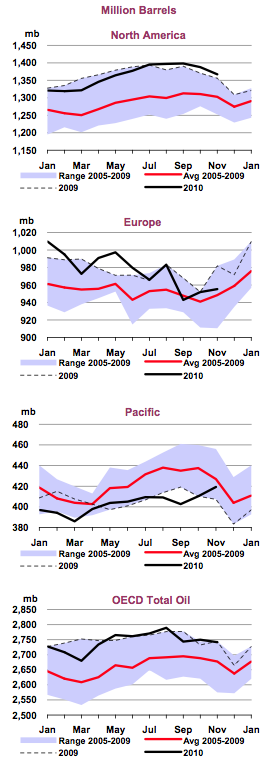 I note with interest that David Fyfe of IEA Paris on Monday attempted to calm world oil markets, by reminding that in the OECD there are over 1.6 billion barrels of oil in inventory. By marshaling these western supplies of already-pumped, above-ground oil, the world could gain a new source of oil for up to one year, at a rate of 4 mbpd (million barrels per day). There are a few sticky issues surrounding such a claim. Not least of which is that oil markets regard drawdowns of above-ground inventories as a reason to send prices even higher. But that point aside, let’s consider what Fyfe did not claim: the head of IEA’s oil markets division did not claim that Non-OPEC oil producers, which account for nearly 60% of world oil supply, could lift supply to make up for the Libyan disruption. That’s no surprise. Non-OPEC oil production has already peaked, and couldn’t increase supply either tomorrow or next year.
In the graphic to the right (click to enlarge) we see the latest publicly available charts for OECD inventories, from the18 January Oil Market Reportfrom IEA. Note that in the bottom chart what’s being accounted for is not only the 1.6 billion barrels of crude that Fyfe refers to, but another 1 billion barrels of oil products. That said, the scale of these large numbers can be a tad misleading. They represent in part just the normal flows of the global oil market and are a snapshot of oil as it flows from production, to refining, and to distribution. For a different measure, these same levels of inventory represent 57.5 days of supply. Which the IEA itself says are the lowest in the past two years.
In truth, the spare capacity that the world cares about—that the oil futures market cares about—is not the inventory level. But rather, actual production capacity that can be brought on immediately. You can see the problem, from a price standpoint. If the world loses Libya’s 1.5 mbpd production for 90-120 days, and starts drawing down above-ground inventories, this only makes the inventory cushion that much thinner for any new supply disruptions. The question on the mind of the oil market therefore is not Mr. Fyfe’s 1.6 billion barrels of crude, but whether countries like Kuwait, the U.A.E. and especially Saudi Arabia or even Russia can lift supply. Immediately.
Of course, “everyone knows” that OPEC is sitting on lots of oil. However, as has been discussed here, at The Oil Drum, and elsewhere, it remains decidedly unclear whether Saudi Arabia can indeed turn on extra taps at will. But the problems for world supply of oil do not merely end with production capacity. Even if OPEC is indeed sitting on 1-3 mbpd of spare capacity, it’s not clear for how long they can both increase production, and export that production to the world. Not only has Saudi Arabia’s production not increased in the past five years, but, Saudi is increasingly using its own oil for its own population. The result? Flat, to declining exports of oil from Saudi Arabia.
Spare Capacity Theory, therefore, looks a lot like an unproven consensus reality. I’d like to define it as follows:
Spare Capacity Theory: the assumption among western bankers, policy makers, economists, and stock markets that OPEC producers can lift oil production at will, and, export all of that spare production to world consumers.
We shall see how much the oil markets themselves believe in this theory. Monday’s five dollar upward price advance—from already high price levels—suggests the market is justifiably concerned about events in Libya, and the risk of more unrest to come in oil producing regions. Given the potential magnitude of this situation, I actually think it's good that we can still rely on price as a means to ration supply.
Further Reading:
Iscriviti a:
Post (Atom)